
THE PHILOSOPHY OF SILENCE
Most of us have quietly learned to be afraid of it.
The empty moment we reach to fill. The gap
we cover with a podcast, a playlist, a scroll.
This page is about what silence is actually doing
while we are busy avoiding it.

Most of us have quietly learned to be afraid of it.
The empty moment we reach to fill. The gap
we cover with a podcast, a playlist, a scroll.
This page is about what silence is actually doing
while we are busy avoiding it.
Silence is not empty. Your body has been waiting for it.
The gap in conversation that needs filling. The empty room that needs music. The commute that needs a podcast. We have built an entire relationship with noise as normal, and silence as something to move past quickly.
And beneath all of that, something in the body is exhausted.
Not from the work. From the sound.
The nervous system is always listening. Always scanning. Every notification, every background hum, every screen – it receives all of it and has to make decisions about all of it. Without pause. Without rest. Without the one thing it needs most.
Silence gives the nervous system permission to stop.
Not because the threats have been removed. Because the input has.
grow in the hippocampus during genuine silence – the part of the brain central to memory, learning, and emotional regulation. This does not happen during stimulation. It happens in stillness.
of silence has been shown to be more relaxing than relaxation music – measurable drops in blood pressure, heart rate, and cortisol
notifications, inputs, or demands required. Silence is not something you have to do. It is something you have to stop.
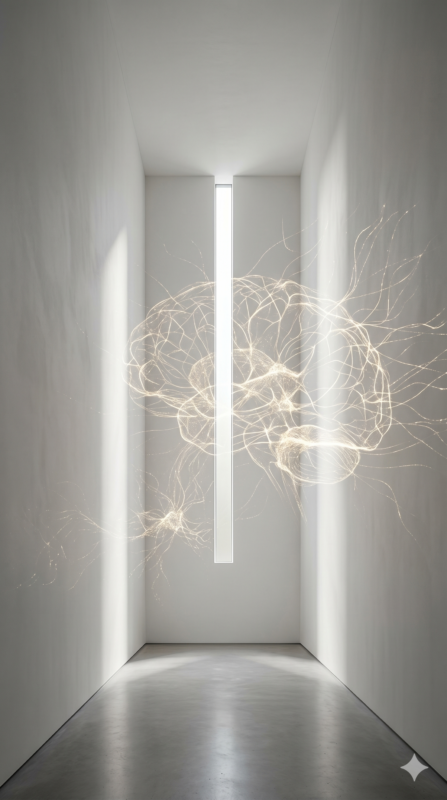
the brain does not rest in silence. it works.
Neuroscience tells us that during periods of genuine silence, the brain grows new cells in the hippocampus. The hippocampus is the region central to memory, learning, and emotional regulation.
This does not happen when we are productive. Not when we are learning, or performing, or creating. It happens in stillness.
The brain also integrates in silence. It processes the experiences we have had, files what matters, releases what does not. This is quiet, invisible work. But it is essential work. And it cannot happen while the world is loud.
Meanwhile, cortisol drops. Blood pressure falls. The heart finds a steadier rhythm. The autonomic nervous system shifts toward the parasympathetic – toward repair and restoration.
Not because we did anything. Because we stopped.
the nervous system has been trained
For many people, silence does not feel peaceful. It feels threatening.
This is not a personality flaw. It is a nervous system response to a world that has made stimulation so constant and so accessible that silence now requires deliberate choice. We do not fall into it. We have to choose it.
The nervous system, always scanning the soundscape for information about safety or threat, does not know what to do when the input stops. It has learned to interpret silence as absence rather than rest. As something to be wary of rather than moved toward.
And so we fill it.
What TEA offers, gently and repeatedly, is a different experience of silence. Not silence as emptiness. Silence as arrival. As the place after birdsong where the body finally begins to do what it has been waiting to do.



Every review is a gift, and we thank all our clients, past and present who have taken the time to share their experience. You can leave your review HERE