
THE SCIENCE OF BREATHWORK
Ancient practice. Modern evidence.
Here is what happens in the body when you breathe consciously –
and what the research actually shows.

Ancient practice. Modern evidence.
Here is what happens in the body when you breathe consciously –
and what the research actually shows.
People have been using conscious breathing to regulate
the nervous system, support emotional health, and
deepen awareness for thousands of years. The science
that explains why it works is considerably more recent.
This page covers the key mechanisms — the autonomic
nervous system, the vagus nerve, heart rate variability,
the research on silence, birdsong, and cortisol — in
plain English, with links to primary sources for
anyone who wants to go further.
The science is offered here as companion to the practice,
not as the reason to trust it. However, for those who
need the evidence before they can let themselves arrive,
this is where to begin.

the root network beneath everything
The autonomic nervous system governs the body’s involuntary functions -heartbeat, digestion, immune response, hormonal balance, the regulation of sleep. It does all of this without a single conscious instruction.
It has two primary branches. The sympathetic branch governs activation – the stress response, the mobilisation for threat or challenge. The parasympathetic branch governs restoration — rest, repair, recovery, and the processes that only run fully when the body feels safe.
Breath is the only function of the autonomic nervous system that we can also consciously choose to change. Every deliberate breath is a direct reach into this system. That single fact is the scientific foundation of everything breathwork does.
the primary carrier of the safety signal
The vagus nerve is the longest cranial nerve in the body, running from the brainstem through the heart, lungs, and gut. It is the primary pathway of the parasympathetic nervous system and carries signals in both directions – from the brain to the body and from the body to the brain.
When the vagus nerve is well-toned, the nervous system can move between activation and restoration with relative ease. Resilience, in physiological terms, is largely vagal tone.
Slow breathing – particularly a longer exhale – directly stimulates the vagus nerve. This is one of the most consistently replicated findings in psychophysiology,
documented across dozens of peer-reviewed studies. Breathwork, practised regularly, tones the vagal nerve.

the documented improvement in mood and wellbeing after 10 minutes of birdsong – including for people living with depression (Hammoud et al., 2022)
average reduction in systolic blood pressure in participants in regular slow breathing programmes across multiple controlled trials
grow in the hippocampus during genuine silence the brain region central to memory, learning, and emotional regulation
(Kirste et al., 2013)

Heart rate variability (HRV) is the variation in time between successive heartbeats. A higher HRV indicates a more adaptable nervous system – one that can respond to demands and return to baseline readily.
Low HRV is associated with chronic stress, burnout, anxiety, cardiovascular risk, and a range of conditions linked to sustained sympathetic activation. High HRV is associated with resilience, recovery capacity, and overall wellbeing.
Slow, regular breathing — particularly at around five to six breaths per minute, known as resonance frequency breathing or coherence breathing — is among the most well-documented interventions for improving HRV. The mechanism is direct: this breathing rate synchronises respiratory rhythm with heart rate in a way that amplifies vagal tone. Research consistently documents improvements in HRV measures following both single sessions and regular breathwork programmes.
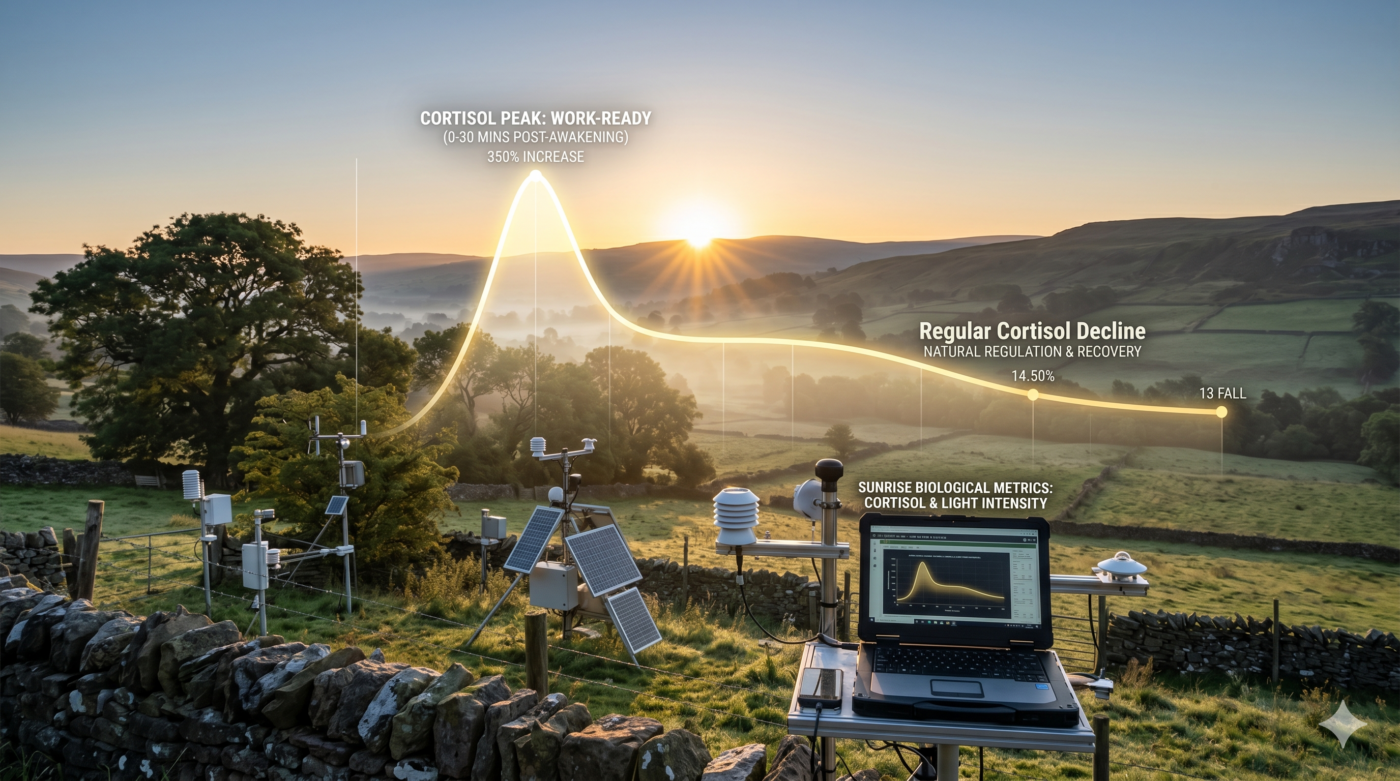
Cortisol is the primary stress hormone – released by the adrenal glands in response to perceived threat or demand. In short bursts this is appropriate and functional. Sustained elevation is associated with immune suppression, sleep disruption, cognitive impairment, and cardiovascular risk.
Research documents measurable reductions in salivary cortisol following breathwork sessions, with effects sustained beyond the session itself in regular practitioners. The mechanism involves both direct vagal stimulation and the reduction of sympathetic nervous system activity that conscious breathing produces.
In addition, birdsong produces documented reductions in cortisol and anxiety measures – with effects persisting for up to eight hours after exposure. This is not incidental to how TEA runs its sessions. It is the scientific rationale for opening every practice with birdsong rather than music or silence alone.

Research by Imke Kirste and colleagues at Duke University documented that two hours of silence per day prompted new cell growth in the hippocampus — the brain region central to memory, learning, and emotional regulation. This does not occur during music, speech, or ambient noise, regardless of volume.
The mechanism involves the nervous system’s response to the absence of demands on its threat-scanning function. Silence does not simply reduce input. It gives the nervous system permission to stop parsing every sound for safety or threat — and in that permission, the brain does its consolidation and regenerative work.
This is the neurological basis for TEA’s use of silence as an active element of every session. The silence between breathwork segments is not empty space.
It is tended space — and the research suggests it is doing some of the most important work of the entire session.
The evidence base for breathwork is growing and genuine. However, an honest summary requires acknowledging its limits.
The strongest evidence exists for slow, regulated breathing and its effects on HRV, blood pressure, and anxiety measures. For conscious connected breathwork specifically, the research is less extensive – partly because the practice is harder to study in controlled conditions and partly because funding for this kind of research has historically been limited.
What the evidence does consistently support is the underlying mechanism: that conscious manipulation of the breath influences the autonomic nervous system in
measurable and meaningful ways. The specific forms and durations associated with the strongest effects continue to be studied.
TEA’s position is this: the body knew before the research confirmed it. The evidence is welcome companion, not primary authority. However, the evidence is real, and it is growing. For anyone who needs it before they can arrive – here it is.
The Midweek Exhale is free. Every Wednesday, 7:30pm UK.
One hour. No experience needed.
JOIN THE MIDWEEK EXHALE →If you are a practitioner considering training —
the Breathwork Research page links to the primary sources,
and a quiet conversation is always available.
This is an invitational wellbeing practice and does not diagnose, treat, or cure any condition. You choose your pace and may rest at any time. If you have medical concerns, please consult a qualified professional.